
The Problem: Reports That Look Fine and Still Can’t Be Trusted
Most ERP conversations start with a transactional problem — a report that doesn’t tie out, a costing figure that looks off, a reconciliation that takes too long. But when we trace these issues back far enough, across engagement after engagement, they tend to converge on the same root: master data.
For several manufacturing and distribution clients, the transactional layer of SAP Business One was working exactly as designed. Sales orders were being raised, purchases were being posted, production was happening. And yet, month after month, MIS packs and dashboards built on top of all that activity didn’t give management a picture anyone fully trusted.
That’s the uncomfortable truth about master data problems: they rarely announce themselves. A report doesn’t fail loudly — it just quietly shows a number that’s slightly, or sometimes significantly, wrong. And because the report still runs and still produces something that looks like an answer, the underlying data issue can go unnoticed for years.
Why Master Data Is the Real Backbone
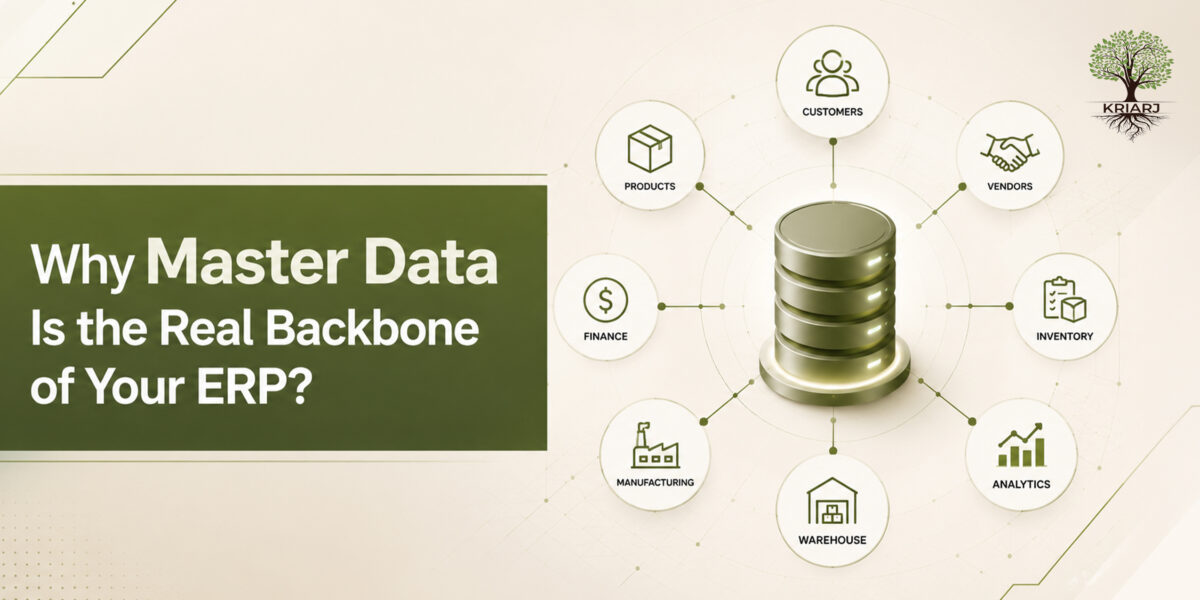
Every transaction in an ERP — a sales order, a goods receipt, a production confirmation — is really just a reference to master records: which customer, which item, which warehouse, which GL account, which BOM. The transaction is only as accurate as the master data it points to.
That means master data isn’t a “setup task” you complete once at implementation and move on from. It’s the foundation every report, every MIS pack, and every dashboard is built on top of, permanently. If that foundation drifts — through duplicate records, inconsistent classifications, or fields that were never maintained after go-live — every layer built above it inherits the distortion, no matter how well-designed the report or how sophisticated the dashboard.
Drilling Into Where Master Data Actually Breaks Down
Across our audit engagements, master data problems tend to cluster around a recurring set of areas:
Customer and Vendor masters — duplicate accounts created because a slightly different spelling or GST number wasn’t recognized as an existing party, incorrect or missing tax classifications, and payment terms that don’t match actual commercial agreements. This alone distorts receivables/payables ageing, credit exposure, and vendor performance reporting.
Item masters — inconsistent item groups and classifications that break category-wise sales and inventory analysis, incorrect valuation methods set at creation and never revisited, missing or wrong unit-of-measure conversions, and inactive items left live in the system.
BOM structures — as we’ve seen directly impact product costing, BOMs that drift out of sync with actual engineering and consumption undermine not just costing but production planning and MRP accuracy.
Warehouse and bin locations — warehouses set up ad hoc over time without a consistent logic, making stock visibility and inventory valuation harder to reconcile location by location.
Chart of Accounts and GL Account Determination — accounts created without a consistent numbering or grouping logic, and automatic GL determination rules that route transactions to the wrong account silently, distorting P&L and balance sheet classification without any error ever appearing on screen.
Individually, each of these looks like a small, forgivable gap. Together, across thousands of transactions a month, they compound into MIS and dashboard numbers that are technically “calculated correctly” but don’t reflect the real picture of the business.
Our Approach: A Structured Master Data Audit
Rather than treating master data cleanup as an ad hoc fix, we run it as a structured audit, module by module:
1. Extraction and profiling — pulling the full master data set (Customer, Vendor, Item, BOM, Warehouse, Chart of Accounts, GL Determination) and profiling it for duplicates, blanks, inconsistent classifications, and outliers.
2. Business rule validation — checking each master record against how the business actually operates today, not just how it was configured at go-live — correct tax treatment, correct valuation method, correct account mapping.
3. Documented findings — a structured report of findings by category and severity, so management can see exactly where the risk sits and prioritize what gets cleaned up first.
4. Correction and governance — cleaning up the identified records, and just as importantly, defining ownership and a review cadence so the same drift doesn’t quietly reappear over the following year.
The Result
Clients who’ve gone through this process consistently find the same thing: the transactional system was never really the problem. Once master data is cleaned up and governed, MIS packs and dashboards start reflecting reality — sales analysis by category becomes trustworthy, receivables ageing lines up with actual customer risk, product costing matches the shop floor, and financial statements stop carrying silent misclassifications.
The Bigger Lesson
An ERP can be perfectly implemented at the transactional level and still produce a distorted picture of the business, if the master data underneath it isn’t accurate and actively governed. Reports, MIS, and dashboards are only as reliable as the data structure they’re built on — no amount of report design or dashboard polish can compensate for a duplicate customer record, a wrong GL mapping, or a stale item classification.
A master data audit isn’t a one-time implementation checklist item. It’s ongoing hygiene — and for any business that wants to trust the numbers it’s making decisions on, it’s the first place to look, before questioning the report on top.
Kriarj Business Consultants Private Limited helps businesses run structured master data audits across Customer, Vendor, Item, BOM, Warehouse, Chart of Accounts, and GL Determination — building the clean, governed foundation that accurate reporting and MIS depend on. If your reports don’t feel like they reflect reality, get in touch at kriarj.com — the answer is usually in the master data.